
 POST-BURNOUT
With a decades-spanning career, the Irish singer-songwriter Pat Carey became best known for fronting the Cork-based fusion band The Hard Ground, which played with elements of indie, electronica, folk, hip-hop, and soul.
While the band enjoyed popularity in the local scene, they decided to call it a day following the release of their third studio album, Triptych, in 2015.
Afterwards, Pat, now a married man with children, dedicated his time to family life, and would read poetry and prose from the likes of Max Porter, Eavan Boland, Sylvia Plath, Sara Baume and Claire Keegan in his spare time.
The structured stoicism and meditative nature of poetry influenced Pat to craft some new material. Inspired by the patient and accepting nature of the waves as observed by the Pulitzer Prize-winning writer Mary Oliver in her poem “I Go Down to the Shore,” he dubbed his new project How I Became A Wave.
“It’s the first time I’ve taken on the full responsibility of the project and the creative part of the project,” Pat told Post-Burnout when discussing how the project differs from his decades of work.
“Now, when I say I’ve taken on the creative lead in the project, I do work with a load of musicians and a load of collaborators, but this is the first time I’ve taken a sense of responsibility around it and owned it, and owned it in a way where I was OK with owning it; not apologetic about owning it.”
Whilst loving the dynamics of contribution and collaboration when he was in a band, Pat’s desire to begin How I Became A Wave was initially driven by the creative freedom a solo project permitted him. “When I don’t have a set line-up of musicians, it means that I have a broader palette to play with,” he explains.
“I don’t have to be like, ‘What’s this person going to play on this song?’, you know? In terms of the creation of it, anyway, it means that you can broaden your horizons. It also means that, stylistically, you can be more open. You can kind of go where you need to go. When I move into future work, I don’t want to be like, ‘This is the sound.’ I want to be able to break it up a little more and play with it.”
Casually playing guitar with a vision of a project that would be relatively minimalistic and acoustic-focused, when Pat had accrued enough songs, he brought them to Wavefield Studios in West Cork to begin shaping them with the producer Brian Casey.
“He’s worked with a load of artists that I really admire,” explains Pat on choosing Casey. “We had a load of sessions down there, and that was the genesis of it. That was the start of it. That was the bit that allowed me to be like, ‘This is legitimate.’ Working with Brian gave me the confidence to own the stuff, and it sounded fantastic.”
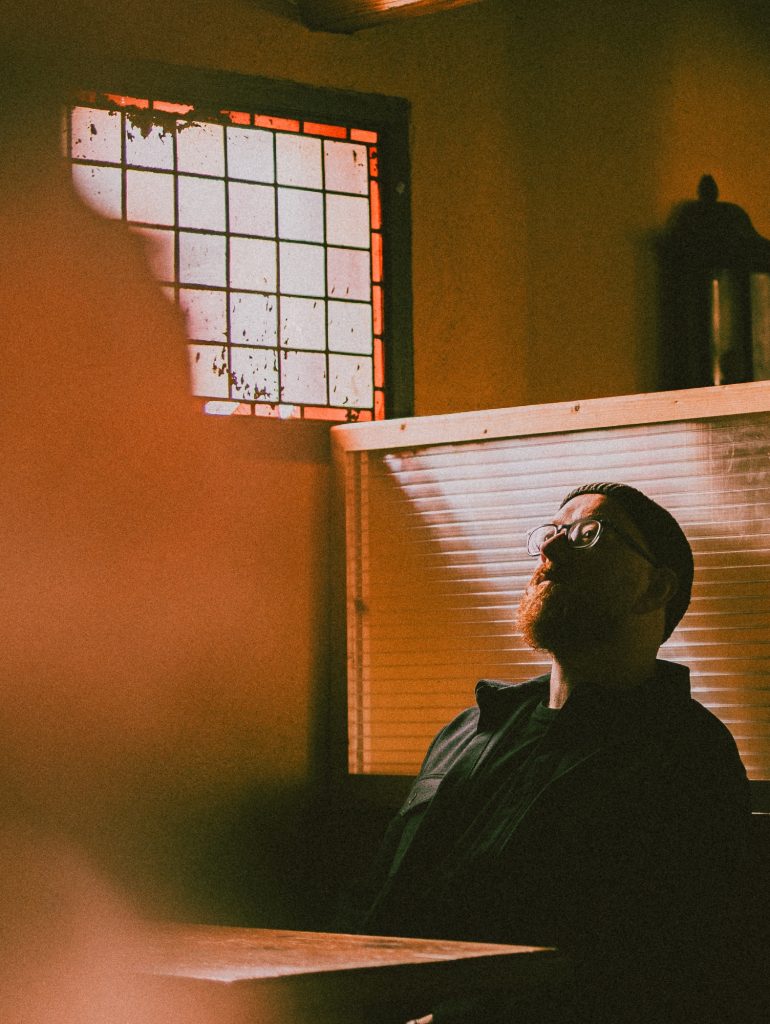
Courtesy of Amplify Agency
Despite the great start, family commitments, work with other collaborators, and the COVID-19 lockdowns would halt the album’s progression, but they persisted, incrementally chipping away to whatever degree they could through any given circumstance.
When a foundation was established, Pat and Casey went through their rolodexes and began drafting musicians to collaborate on the album, but, given the lockdown measures, most worked remotely, with Pat admitting that there are personnel he has still never met to this day.
Post-lockdowns, the gears on production began churning regularly, but Pat found a snag when he returned to the studio to record his vocals. “A number of years were after passing, and I realised that I sounded a little bit different,” Pat explains.
“Age started pulling at my vocal cords. Not just in terms of what notes you’re getting or whatever, but even the tambour and tone of your voice. I was listening back to some of the stuff, and I was like, ‘Jesus, that’s gorgeous, but I don’t necessarily sound like that now!’
“We had to re-record a couple of songs, specifically, because I was like, ‘I’m not going to be able to do that,’ you know? ‘I’m not going to be able to sing that,’ you know? Which was kind of a little bit bonkers, but it was real.
“It meant that not only did we have to look at a little bit of re-recording of stuff, but I had to rethink some of the music, because the change in tone of my voice required different instruments at that point.”
The record’s production took nearly a decade to complete. What kept Pat persistent, rather than simply diverting attention to less time-consuming singles to establish the project, was how he envisioned his songs. “For me, it’s an album, and it’s a piece of work,” he explains.
“Even though it took so long, from a writing perspective, it’s supposed to be one body of work, I think, and there’s lots of different linking themes… – whether it’s musically or lyrically – …throughout the album. For me, anyway.
“I’m not saying that everyone should be able to find all these threads and links, but from a writing perspective, there were links the whole way through.”
Released on March 27th, How I Became A Wave’s debut album is chock-full of emotionally rich and deeply reflective songs, but Pat specifies that, while he didn’t wish to shy away from any true emotion, he wanted to add enough ambiguity to allow each listener to impose their interpretations and life onto his lyrics.
“You have to be careful in your writing about how much emotion or story that you’re putting in,” Pat explains. “You want to create a space that people can fill with their own experiences, and I would hope that I could invite people in and that there’s space for people to bring their emotions to, without necessarily being sad songs.
“Most of this album, it probably sounds like it’s sad, but it’s not supposed to be a sad album; it’s supposed to be an album you can go to.”
When we spoke, it was the eve of the album’s release. “Because the gestation period has been so long, the main thing as I come up to it is relief,” said Pat on his feelings at the time.
“Relief and a certain sense of pride, but not necessarily pride in what I’ve done, but the fact that I’ve gotten here, more than anything else. I am excited, but it’s more like a slow-burn excited. It’s like a slow release.”
To promote the record, How I Became A Wave are going on a nationwide tour, beginning on April 12th at Coughlin’s in Cork, and finishing on June 4th, where they’ll support Lisa O’Neill at the Galway Folk Festival at the Town Hall Theatre.
“It’s going to be different every evening,” Pat says of what people can expect from the tour. “Whether that’s the line-up or the flow of the songs. I think that all of the venues have a sense of intimacy.
“Even the Dublin one at the Unitarian Church, there’s maybe six or seven of us on stage that evening, so it’ll be bigger, but the idea is that it will be quiet and intimate, as well. So, every place that we’re playing on this [tour], it’s about inviting people to listen, rather than hitting them in the face with the songs.”
How I Became a Wave’s self-titled debut album is out now. You can keep up with the project through their website.
You can see How I Became a Wave performing at:
April 12th – Cork – Coughlan’s (Matinee)
April 12th – Cork – Coughlan’s (Evening)
April 17th – Dublin – Unitarian Church
April 19th – Kinsale – Prim’s Bookshop: Bibliotherapy
April 30th – Ballybofey – The Ghostlight Sessions @ Balor Arts Centre
May 16th – Ballydehob – Levis Corner House
June 4th – Galway – Galway Folk Festival @ Town Hall Theatre (supporting Lisa O’Neill)
Tune into POSTBURNOUT.COM Interviews… tonight at 22:30 (IST) to hear this interview in full. Available on YouTube, Spotify, Apple Podcasts, and Amazon Music Podcasts.
Aaron Kavanagh is the Founder and Editor-in-Chief of Post-Burnout. His writing can also be found in the Irish Daily Star, Buzz.ie, Totally Dublin, The GOO, Headstuff, New Noise Magazine, XS Noize, DSCVRD and more.